Essay
Projection: The Shadow of a Vector
Orthogonal projection turns the intuitive idea of a shadow into one of linear algebra's most useful operations.
Projection asks a beautifully simple question:
How much of lies in the direction of ?
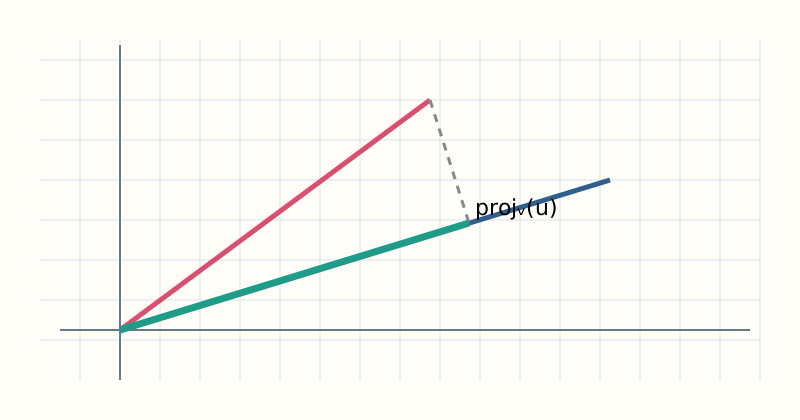
For nonzero ,
If is a unit vector, this becomes
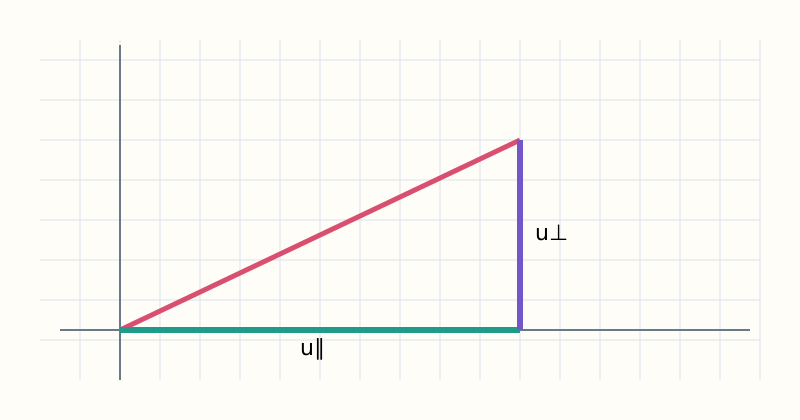
A decomposition
Projection naturally splits a vector into two pieces:
where lies along and is perpendicular to it.
From shadows to least squares
When a system has no exact solution, least squares finds the point in the column space of closest to . In other words, it projects onto a subspace.
The residual
must be perpendicular to every column of , giving
Hence the normal equations:
Projection is therefore not a decorative geometric idea. It is hiding inside regression, approximation, signal processing and machine learning.