Basis: Choosing Coordinates for a World
A basis is not the vector space; it is the coordinate language we choose to describe it.
A vector is an object. Its coordinates are a description of that object relative to a chosen basis.
That distinction is easy to miss because in school we almost always use the standard basis and .
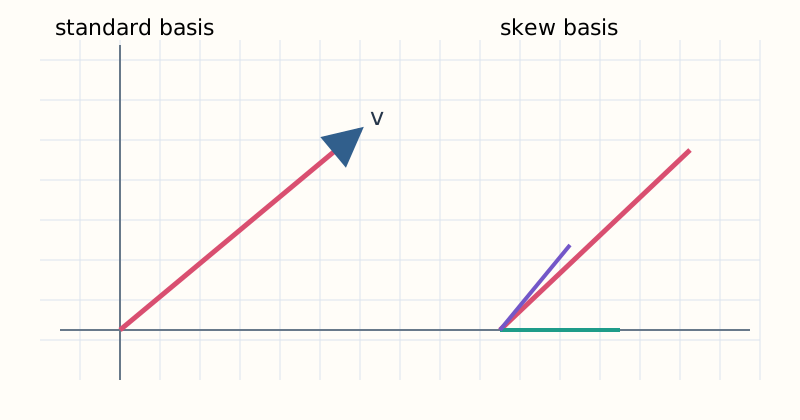
What makes a basis?
A basis must do two things:
- span the space — every vector can be built from it;
- be linearly independent — none of the basis vectors is redundant.
Then every vector has a unique representation
The tuple is not the vector itself. It is the vector’s address in that coordinate system.
✦ A Connection Worth Noticing
Choosing a basis is like choosing vocabulary. The underlying thought may remain the same while its representation changes.
Change of basis
If is the matrix whose columns are the new basis vectors, then
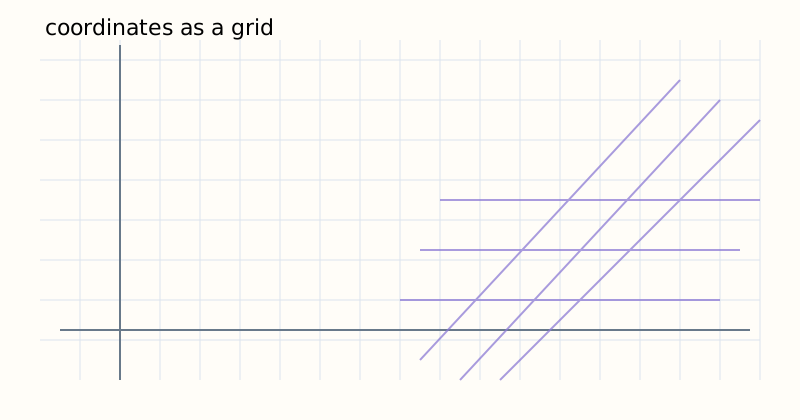
Why this matters later
Eigenvectors give us a particularly revealing basis. Fourier analysis chooses sinusoidal basis functions. PCA chooses directions of maximal variance. Neural representations can be viewed through many coordinate systems.
The recurring lesson is:
coordinates are negotiable; structure is not.
Where next?
Continue with Linear Transformations to see what matrices do to an entire basis and grid.