Why the Dot Product Knows the Angle
Projection, cosine and the geometric meaning hidden inside a familiar algebraic operation.
For vectors and ,
The formula can look like a curious algebraic coincidence. It is not. The dot product measures directional agreement: how much one vector points along another.
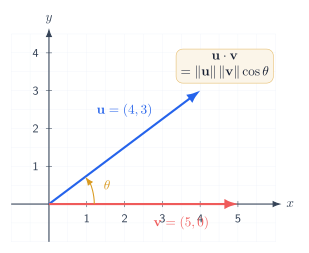
First, forget the formula
Imagine standing at the origin and looking in the direction of . Now ask:
How much of lies in that direction?
That question is projection.
Projection comes first
The scalar projection of onto the direction of is
Geometrically, drop a perpendicular from the tip of to the line containing .
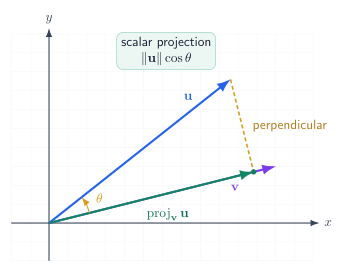
Now multiply this signed projected length by :
So the dot product can be read as:
the amount of one vector in the other’s direction, scaled by the other’s length.
Why the sign tells a story
Because cosine changes sign as the angle crosses , the dot product immediately tells us whether the two vectors broadly cooperate, ignore one another, or oppose one another.
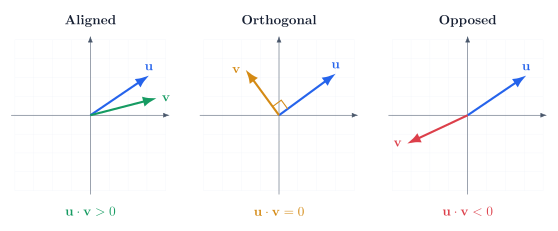
This is why orthogonality has the beautifully compact algebraic test
And then algebra gives the same quantity
If
then
The remarkable fact is that this component-wise arithmetic and the geometric expression involving lengths and angle are the same scalar.
That identity is one of the bridges that makes linear algebra so powerful: coordinates let us calculate, while geometry lets us understand what the calculation means.
Why machine learning cares
Once vectors represent documents, images, users, products, or words, the same geometry survives. Cosine similarity is simply the normalized dot product:
The coordinates may live in hundreds or thousands of dimensions, where we can no longer draw the arrows, but the inner-product geometry still lets us ask whether two representations point in similar directions.
That is why an elementary-looking operation from school geometry reappears everywhere from mechanics to Word2Vec and attention mechanisms.